
Solar energy photovoltaic technology converts sunlight directly into electricity using semiconductor materials that generate an electrical current when exposed to light. This process, known as the photovoltaic effect, powers everything from residential rooftops to massive utility-scale solar farms, making it one of the fastest-growing renewable energy sources worldwide.
If you’re considering solar panels for your home or business, understanding how photovoltaic systems actually work is the first step toward making an informed investment. The technology has advanced dramatically in recent years, with panels becoming more efficient, affordable, and accessible than ever before. What once seemed like a futuristic dream is now a practical reality for millions of property owners looking to reduce energy bills and environmental impact.
This article breaks down the science behind photovoltaic systems in straightforward terms, explaining the mechanics that transform sunlight into usable power. You’ll discover the different types of solar panels available in 2026, learn what makes each option suitable for specific situations, and see real-world examples of how homeowners and businesses have successfully implemented this technology.
Whether you’re trying to understand the fundamental process before contacting installers or weighing which panel type fits your roof and budget, the following sections provide the technical knowledge you need without the engineering degree. From silicon cells to inverters, from monocrystalline to thin-film panels, we’ll guide you through the essential concepts that matter most for your solar decision.
What Solar Photovoltaic Technology Means
Solar photovoltaic technology converts sunlight directly into electricity through a process called the photovoltaic effect. When you see solar panels on rooftops or in solar farms, you’re looking at photovoltaic systems at work. The term itself comes from two parts: “photo” meaning light, and “voltaic” relating to electricity. Together, they describe what happens inside those blue or black panels, light energy transforms into electrical energy you can use to power your home or business.
This differs significantly from solar thermal technology, which many people confuse with photovoltaic systems. Solar thermal uses sunlight to heat water or air directly, typically for home heating or hot water. Photovoltaic panels, on the other hand, generate electricity that can power anything in your home, from lights and appliances to air conditioning and electric vehicle chargers. While both harness the sun’s energy, they serve different purposes and use completely different mechanisms.
Understanding a few key terms helps clarify what you’re actually investing in when you choose photovoltaic technology:
- Photovoltaic Effect
- The physical process where certain materials generate an electric current when exposed to light. This is the fundamental science that makes solar panels work.
- Solar Cell
- The smallest unit of a photovoltaic system, typically made from silicon, that converts light into a small amount of electricity. Individual cells produce only about 0.5 volts each.
- Solar Module
- What most people call a solar panel, a collection of solar cells wired together and encased in a protective frame. A typical residential module contains 60 to 72 cells.
- Solar Array
- Multiple solar modules connected together to form a complete system. Your rooftop installation is an array, sized to meet your energy needs.
- Inverter
- The device that converts the direct current (DC) electricity from your panels into alternating current (AC) electricity your home can use. It’s the crucial bridge between solar generation and household power.
When you invest in photovoltaic technology, you’re purchasing a complete system built from these components. The technology is proven and reliable, with panels routinely lasting 25 years or more while requiring minimal maintenance.
How Photovoltaic Energy Mechanics Work
The Photovoltaic Effect Explained
At the heart of every solar panel is the photovoltaic effect, a phenomenon where certain materials generate electricity when exposed to light. Think of it like a microscopic waterwheel: just as flowing water spins a wheel to create mechanical energy, photons (particles of light) strike atoms in the panel’s silicon material and knock electrons loose.
Silicon is what scientists call a semiconductor. It doesn’t conduct electricity as well as metals do, but it has a special property. When manufacturers process silicon for solar cells, they create two layers with different electrical properties. One layer has extra electrons (negative charge), while the other has spaces where electrons are missing (positive charge).
When sunlight hits this silicon sandwich, it energizes electrons enough to break free from their atoms. The built-in electrical field between the two layers then pushes these free electrons in one direction, creating a flow of electrical current. That flow is what powers your home. The brighter the sunlight, the more electrons get knocked loose, which is why solar panels produce more electricity on sunny days than cloudy ones.
From Solar Cell to Home Power
A single photovoltaic cell produces only a tiny amount of electricity, around 0.5 volts, barely enough to power a small LED. To generate useful power for your home, dozens of these cells are connected together into a solar panel (also called a module). A typical residential panel contains 60 to 72 cells and produces between 300 and 400 watts under ideal conditions.
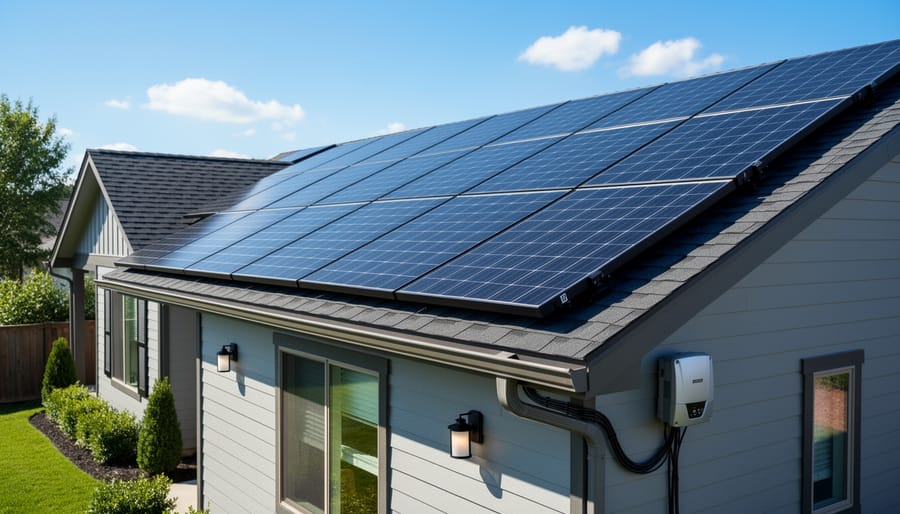
Most homes need multiple panels to meet their energy needs. When you install solar panels they’re wired together into an array, the complete system mounted on your roof or property. A modest home might use 15 to 20 panels, while larger properties or higher energy users need more. The array generates direct current (DC) electricity, the same type that flows from a battery.
Your home runs on alternating current (AC) electricity, which is what the power grid supplies. This is where the inverter becomes essential. Mounted near your electrical panel or beneath the panels themselves, the inverter converts the DC electricity from your array into AC electricity that your appliances and lights can use. Modern inverters also monitor system performance and can shut down safely if there’s a grid outage.
From the inverter, electricity flows through a dedicated circuit breaker into your main electrical panel, where it’s distributed throughout your home just like grid power. When your panels produce more electricity than you’re using, the excess typically flows back to the grid (if you have net metering), spinning your meter backward and earning you credits. At night or during cloudy periods when production drops, you draw power from the grid as usual. This seamless back-and-forth happens automatically, with no switches to flip or systems to manage.
Types of Photovoltaic Solar Panels
Monocrystalline Panels
Monocrystalline panels are the most efficient PV technology available for residential installations. You can identify them by their uniform black or dark blue appearance and rounded cell edges. These panels achieve monocrystalline higher efficiency ratings (typically 18-22%) because they’re made from single, pure silicon crystals that allow electrons to move more freely.
This efficiency advantage translates to real benefits. A monocrystalline panel can generate 20-25% more power than a polycrystalline panel of the same physical size. For homeowners with limited roof space or shading challenges, this means you can produce the electricity you need without covering your entire roof.
These panels work exceptionally well in space-constrained situations like urban homes, properties with complex roof layouts, or installations where aesthetics matter. Their sleek, consistent appearance also appeals to homeowners who want a clean look. While they cost more upfront than polycrystalline options, the combination with other PV system components typically delivers better long-term value when roof space is at a premium.
Polycrystalline Panels
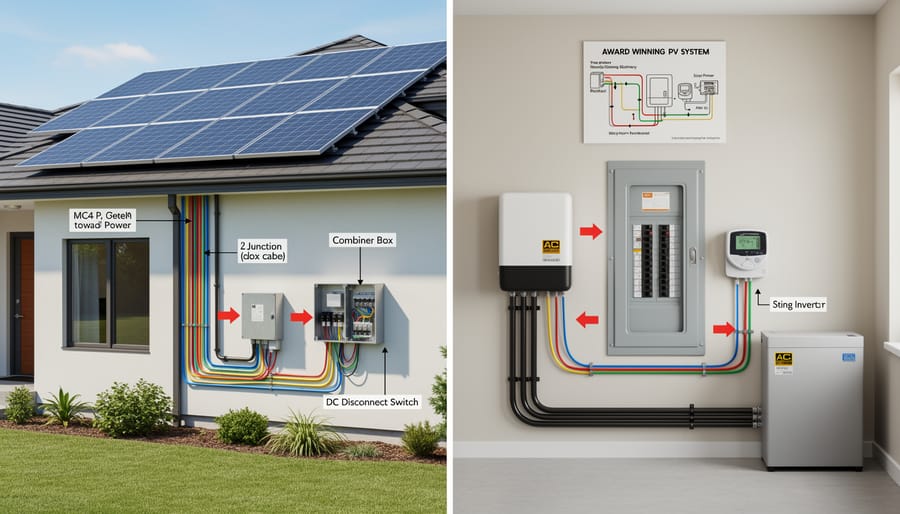
Polycrystalline panels are made from silicon fragments melted together, creating the distinctive blue, multi-faceted appearance you might notice on rooftops. Unlike monocrystalline cells cut from single silicon crystals, these use recycled silicon scraps, which makes manufacturing simpler and less energy-intensive.
The trade-off? Efficiency typically runs 15-17%, compared to 18-22% for monocrystalline. You’ll need roughly 10-15% more roof space to generate the same power. But polycrystalline panels cost 10-20% less upfront, making them attractive when you have plenty of available roof area and want to minimize initial investment.
They make particular sense for homeowners with large, unobstructed roofs where space isn’t a constraint. A ranch-style home with a sprawling south-facing roof, for instance, can accommodate the extra panels without issue. The cost savings over a 25-panel system might reach $800-1,200, money you could redirect toward battery storage or other upgrades.
Performance in hot climates is slightly lower than monocrystalline, but the difference rarely outweighs the price advantage for budget-conscious installations.
Thin-Film and Emerging Technologies
Thin-film panels represent a different manufacturing approach than crystalline silicon. Instead of thick wafers, manufacturers deposit ultra-thin layers of photovoltaic material onto glass, plastic, or metal substrates. This creates lightweight, flexible panels that perform better in partial shade and high temperatures. While their efficiency typically ranges from 10-13% (lower than crystalline options), thin-film excels in specific applications. If you have ample roof space and want panels that maintain consistent output during hot summers, thin-film deserves consideration. They’re also ideal for curved surfaces or building-integrated applications where traditional panels won’t fit.
Bifacial modules are gaining traction in residential installations. These panels capture sunlight from both sides, generating additional power from light reflected off your roof surface or the ground below. On white roofs or reflective surfaces, homeowners see 5-30% more energy production than standard panels. The technology works with both monocrystalline and polycrystalline cells, offering flexibility in your system design.
Several emerging technologies are entering the market. Perovskite solar cells promise higher efficiency at lower manufacturing costs, though long-term durability is still being proven. Some manufacturers now offer panels with integrated microinverters, simplifying installation and improving system monitoring. Transparent solar panels are being developed for windows, potentially turning every glass surface into an energy generator. While most emerging technologies aren’t ready for widespread residential use, they demonstrate the industry’s continued innovation in making solar more accessible and efficient.
Real-World Applications of Photovoltaic Energy
Residential Solar Success Story
When Sarah Martinez decided to go solar in 2024, she wasn’t sure what to expect. Her Denver home’s monthly electric bills had climbed above $180, and she’d grown tired of unpredictable rate increases. After consulting with installers about how many panels her roof could support, she settled on a 7.2 kW system, 20 monocrystalline panels facing south.
The results exceeded her hopes. In the first year, Sarah’s system generated 9,400 kWh, covering about 85% of her household’s electricity needs. Her bills dropped to an average of $22 monthly, mostly grid connection fees. Over 18 months, she’s saved roughly $2,800, putting her on track to recover the system cost in under eight years.
“The monitoring app shows real-time production, which honestly became a bit addictive at first,” Sarah laughs. “I loved watching the panels generate power during the day. But the best part? I haven’t worried about summer AC costs in two years.”
She did encounter one surprise: snow accumulation reduced winter output more than anticipated. Still, annual production matched projections, and her installer’s performance guarantee provided peace of mind. Sarah now recommends solar to neighbors, emphasizing that understanding your roof’s potential and realistic production estimates makes all the difference.
Business and Commercial Uses
Large commercial buildings have discovered that photovoltaic systems offer substantial advantages beyond environmental benefits. Businesses install PV arrays primarily to reduce operating costs, commercial electricity rates often include demand charges and time-of-use pricing that make solar particularly valuable. A manufacturing facility paying peak rates during daytime production hours can offset those exact high-cost periods with solar generation.
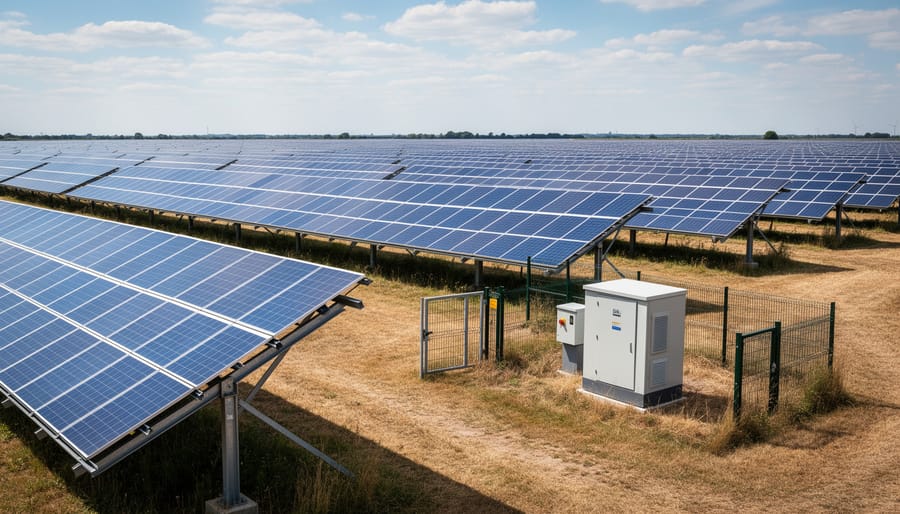
Warehouses and retail centers leverage their expansive flat rooftops, previously unused space, to host solar installations that can cover 40-70% of their energy needs. These systems typically range from 100 to 500 kilowatts, generating enough power to run HVAC systems, lighting, and equipment during business hours.
A distribution center in Arizona installed a 250-kilowatt rooftop system in 2024 that now produces approximately 400,000 kilowatt-hours annually. The company reports $48,000 in yearly electricity savings and qualified for accelerated depreciation through federal tax incentives, recovering their investment in under six years. The installation also reduced their carbon footprint by roughly 280 metric tons of CO2 annually, a metric they now highlight in sustainability reports to clients and investors.
Corporate solar adoption extends beyond immediate savings. Companies use PV installations to demonstrate environmental leadership, attract eco-conscious customers, and meet corporate sustainability commitments. For businesses with multiple locations, standardized solar deployments create predictable long-term energy costs while insulating operations from utility rate increases.
Key Factors Affecting Photovoltaic Performance
Understanding what affects your PV system’s output helps you make smarter decisions about panel placement and maintain realistic expectations about performance. Several interconnected factors determine how much electricity your panels actually produce.
Sunlight availability matters most. Panels in Phoenix generate more power than identical systems in Seattle simply because Arizona receives more direct sunlight throughout the year. The sun’s angle changes with seasons, winter production typically drops because sunlight hits panels at less optimal angles and daylight hours shrink.
Temperature plays a counterintuitive role. While panels need sunlight, excessive heat reduces efficiency. Most crystalline silicon panels lose about 0.5% efficiency for every degree Celsius above 25°C (77°F). This means a scorching summer day might produce less power than a cool, sunny spring afternoon with the same light intensity.
Key performance factors include:
- Sunlight intensity and the angle at which it strikes your panels
- Ambient temperature and panel operating temperature
- Shading from trees, chimneys, or neighboring buildings
- Panel orientation (south-facing in the Northern Hemisphere) and tilt angle
- Weather conditions including clouds, dust, and snow accumulation
- System maintenance such as cleaning and component inspections
Even partial shading significantly impacts output. Modern systems use microinverters or power optimizers to minimize this effect, but a shadow covering just one panel can reduce production across connected panels in older string inverter setups.
Your installation choices directly influence your solar savings. Professional installers assess your roof’s orientation, local weather patterns, and potential shading to maximize production. Adding battery backup lets you store excess midday production for evening use, further optimizing your system’s value regardless of daily performance variations.
Common Questions About Photovoltaic Technology
People considering solar panels typically have a handful of practical worries before they commit. You wonder whether the investment will hold up, how the technology handles less-than-perfect conditions, and what happens when the sun isn’t shining. These are smart questions, and understanding the real answers helps you set realistic expectations for your system.
How long do photovoltaic panels actually last?
Most panels come with 25-year performance warranties and continue producing electricity well beyond that, typically degrading only 0.5% per year. Many installations from the 1980s still generate power today, though at reduced efficiency.
Do solar panels work on cloudy days?
Yes, they still produce electricity in overcast conditions, just at 10-25% of their peak output depending on cloud density. Even regions with frequent cloud cover like Seattle and Portland support thriving solar markets because panels collect diffused sunlight throughout the day.
What maintenance do PV systems need?
Minimal upkeep, rain usually handles cleaning, though dusty climates may need occasional hosing. You should check once or twice yearly for debris buildup, shading from new tree growth, and verify your inverter is functioning properly.
What happens to my power at night?
Without battery storage, your home draws from the grid after sunset, while any daytime excess you produced earlier typically feeds back through net metering programs that credit your account. Battery systems let you store solar electricity for nighttime use instead.
Warranties typically cover two aspects: the panel manufacturer guarantees the modules themselves for 10-12 years against defects, while the performance warranty promises they’ll still produce at least 80-85% of their original output after 25 years. Your installer usually provides separate workmanship warranties covering mounting, wiring, and installation quality for 5-10 years.
Recyclability is improving as the industry matures. Silicon panels contain valuable materials like silver, copper, and semiconductor-grade silicon that specialized facilities can recover. Several states now require panel recycling programs, and manufacturers are designing modules for easier end-of-life processing. While the infrastructure isn’t everywhere yet, panels installed today will reach recycling age when recovery systems are far more developed than they are now.
Understanding how photovoltaic technology works puts you in control of your solar investment. You now know that PV panels convert sunlight directly into electricity through the photovoltaic effect, that different panel types suit different needs and budgets, and that real homeowners and businesses are already seeing measurable savings and environmental benefits.
This knowledge matters when you’re comparing quotes, asking installers questions, or deciding whether solar makes sense for your property. You can evaluate system proposals based on actual performance factors rather than marketing claims. You can spot when efficiency numbers genuinely matter for your roof space versus when a lower-cost option delivers better value.
Solar photovoltaic technology isn’t experimental or risky. It’s proven, increasingly affordable, and backed by decades of real-world performance data. The panels on your neighbor’s roof use the same fundamental physics you’ve learned here.
Whether you move forward with installation next month or in a few years, you’re equipped to make that decision confidently. Start by getting quotes from local installers, asking about panel types and expected production for your specific location, and reviewing financing options that align with your goals. The technology is ready when you are.