
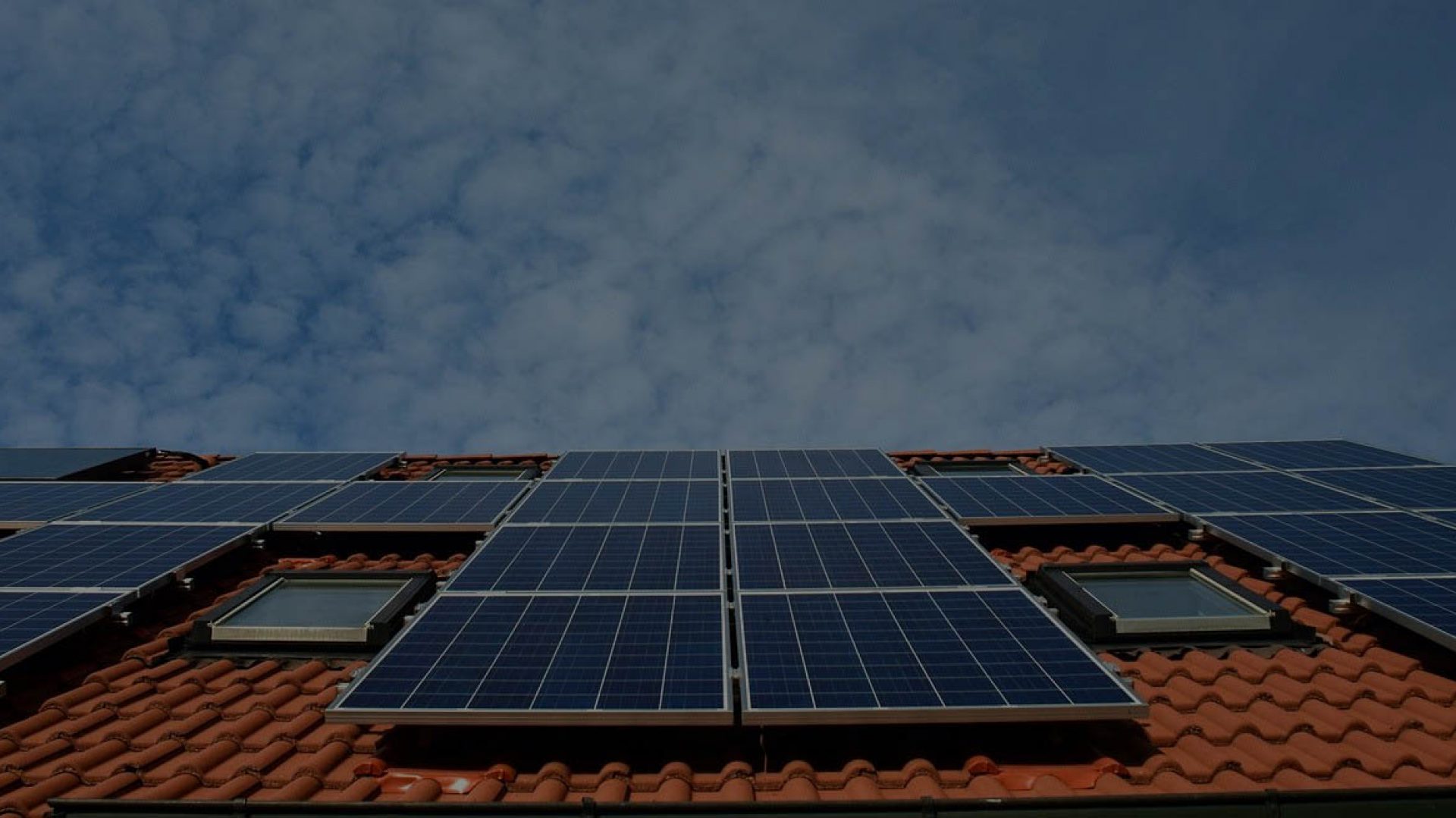
Four solar panels in series means the panels are wired in a single chain, with the positive terminal of one connected to the negative terminal of the next. The result is that their voltages add together while the current stays the same as that of a single panel. Think of it like four people stacking their shoulders to reach a higher shelf: the height (voltage) climbs, but the flow of water (current) through the pipe doesn’t change.
Here’s why that matters. Higher voltage lets electricity travel through thinner wire with less loss, and it gives many charge controllers and inverters the minimum voltage they need to start working. For a cabin, an RV, or a backyard shed, that can mean a cleaner install and a smaller wiring bill.
The math is refreshingly simple. If each panel is rated at 20 volts and 5 amps, a four-panel series string delivers about 80 volts at 5 amps. That’s the same 400 watts you’d get from wiring them in parallel, just packaged differently. If you’d like a refresher on how sunlight becomes usable electricity in the first place, our guide to PV technology basics covers it in plain language.
Below, we’ll walk through the voltage and current math, the components you’ll need, how series compares with other layouts, and the sizing and safety checks that keep your system happy.
What Four Solar Panels in Series Actually Means
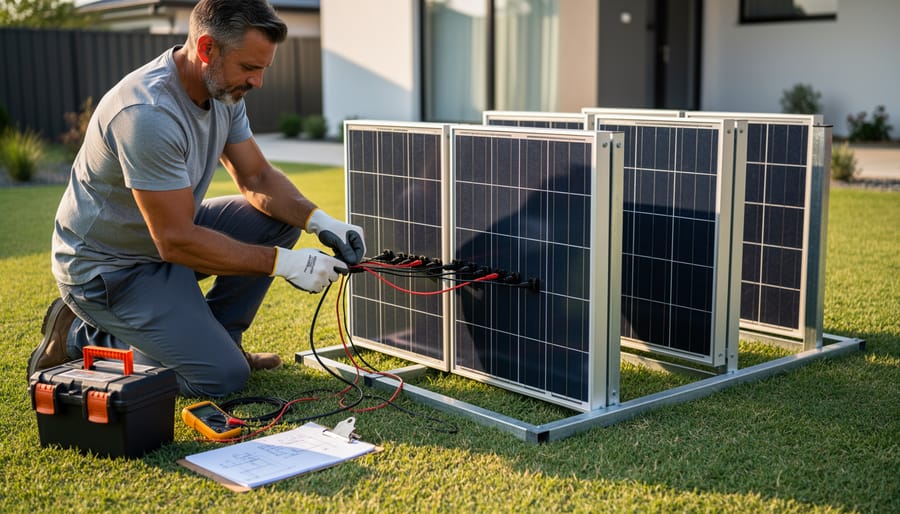
Picture four panels on your workbench, each with two wires hanging off the back, one positive and one negative. A series connection simply links them end to end: the positive wire of one panel clips to the negative wire of the next, and so on down the line. What you end up with is one long chain, called a string, with a single open positive wire at one end and a single open negative wire at the other.
Think of a flashlight with four batteries stacked nose to tail. Each battery adds its push to the one before it, so the light gets a much stronger shove than any single battery could give. Solar panels in series work the same way. The “push” stacks up, but the flow stays the same.
Before the math comes later, here are the everyday terms you’ll keep running into:
- Series connection
- Wiring panels in a line, positive to negative, so their electrical push adds together while the flow stays the same.
- String
- The single chain of connected panels, which acts like one bigger panel with two wires coming out.
- Voltage (volts)
- The pressure pushing electricity through the wires, a bit like water pressure in a hose.
- Current (amps)
- How much electricity flows past a point each second, like how much water moves through the hose.
- Watts
- The total power you get, found by multiplying volts by amps.
- Open-circuit voltage and maximum power point
- Open-circuit voltage is the most pressure a panel shows when nothing is connected, while the maximum power point is the sweet spot where it delivers the most watts under load.
In plain terms, wiring four panels in series multiplies the pressure by four but doesn’t change how much flows. The wattage still adds up to the sum of all four panels, just delivered at a higher voltage. You’ll see why that matters in the next sections.
How Wiring Four Panels in Series Works
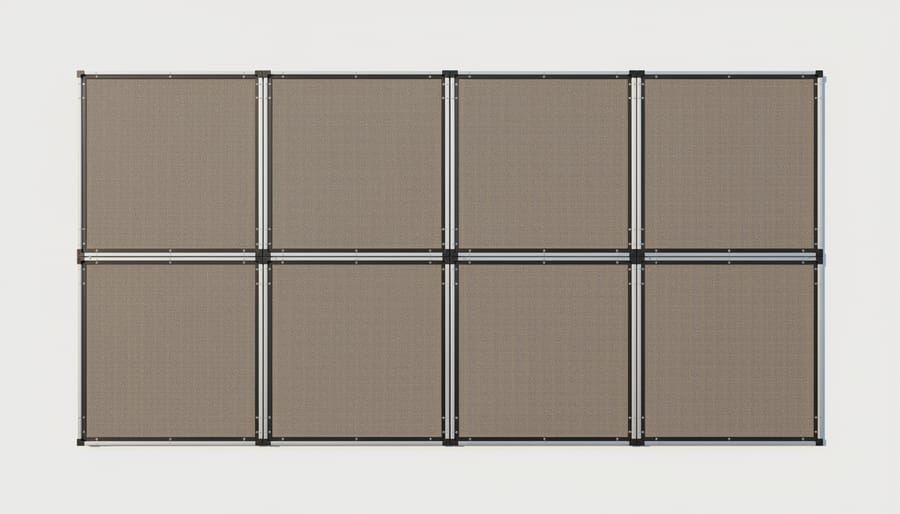
The Math: Adding Up Voltage, Keeping Current Steady
Let’s run the numbers on a typical panel. Grab the label on the back of yours and find three figures: Vmp (voltage at maximum power), Imp (current at maximum power), and Voc (open-circuit voltage). For this example, we’ll use illustrative values of 40 V, 10 A, and 48 V, so swap in your own.
Step 1: Add the voltages. In a series string, each panel stacks its voltage on top of the last one.
4 panels × 40 V = 160 V
Step 2: Keep the current the same. Current doesn’t add up in a series chain. It flows through every panel in turn, so the string carries the same amount as a single panel.
String current = 10 A
Step 3: Find the wattage. Multiply the string voltage by the current.
160 V × 10 A = 1,600 W
You’d get the same answer by adding up the four panels’ individual ratings (4 × 400 W). That’s a handy check that your math is on track.
A friendly reminder about cold weather. Solar panels actually produce higher voltage when it’s cold, and a crisp, sunny winter morning is when your string hits its peak. So when you’re matching your string to a charge controller or inverter, don’t rely on the everyday Vmp number. Use the Voc, then adjust it using the temperature coefficient listed on your panel’s spec sheet for the coldest temperature you expect at your site.
Using our example, a Voc of 48 V per panel means 192 V for the string before any cold-weather boost. Your equipment’s maximum input voltage needs to sit comfortably above whatever number you land on.
Why the Weakest Panel Sets the Pace
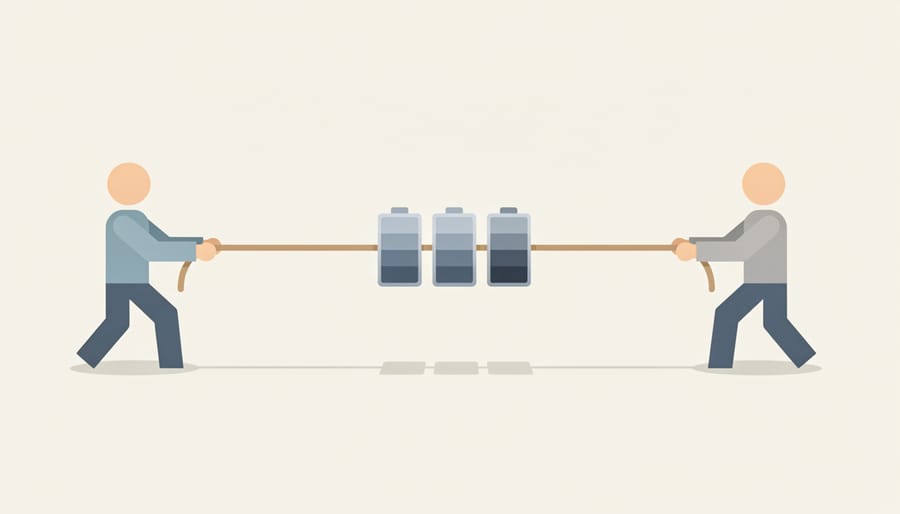
Picture a garden hose running across your lawn. Water pushes through at a steady rate, but if one section gets kinked, the flow slows down everywhere along the line. It doesn’t matter that the rest of the hose is wide open. The kink sets the pace for the whole thing.
A series string of four panels works the same way. Because the same current flows through every panel, the panel producing the least current limits the rest. Say a neighbor’s chimney throws a shadow across one panel for part of the afternoon. That one panel might drop to a fraction of its normal output, and the entire string can follow it down, even though the other three are sitting in full sun. A thick layer of dust, a pile of leaves, or bird droppings can do the same thing. So can a mismatched panel with different electrical ratings from the others, which is why most installers wire panels of the same model together.
Luckily, there are built-in safeguards. Most panels include bypass diodes, small electrical “detours” that let current skip around a shaded or struggling section of the panel instead of getting stuck behind it. You lose some power from that section, but the whole string no longer gets dragged down to the same degree.
Optimizers go a step further. These small devices attach to individual panels and adjust each one’s output on its own, so a shaded panel can’t hold back its neighbors. They add cost, so they tend to make the most sense where shade is hard to avoid.
Series vs. Parallel vs. Series-Parallel: Choosing a Wiring Layout
The Gear You Need for a 4-Panel String
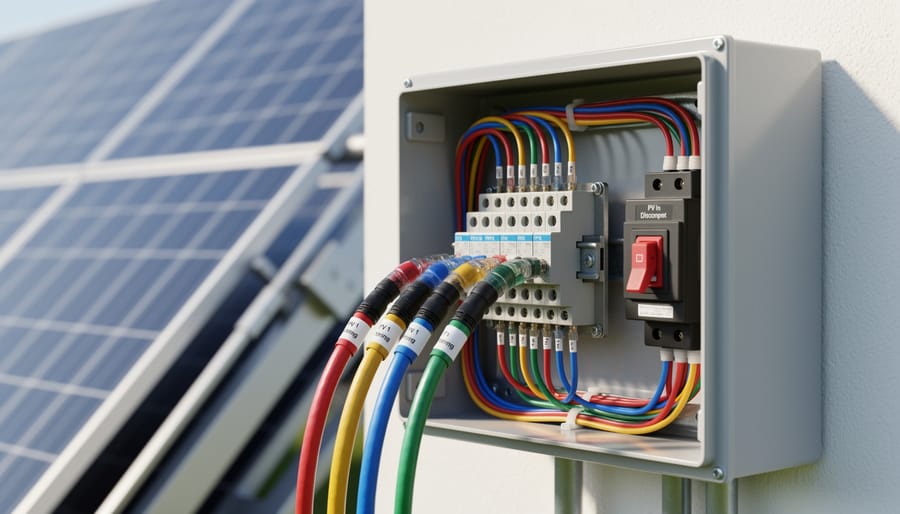
Wiring four panels in series takes only a handful of parts, and most of them are small and inexpensive. Here is what a typical string needs:
- Four matching solar panels: the power source, ideally the same model so their voltage and current line up.
- MC4 connectors: weatherproof plugs that snap the panels together, positive to negative, in a chain.
- String cable: UV-rated solar wire that carries the combined power from the last panel to your equipment.
- MPPT charge controller or string inverter: the brain that turns raw panel output into something your batteries or home can use.
- Disconnect switch and breaker or fuse: a way to shut the system off safely and protect the wiring from overloads.
- Grounding hardware: lugs, clamps and wire that give stray electricity a safe path to the earth.
The detail that trips up the most beginners is voltage. Because series wiring adds each panel’s voltage together, your controller or inverter must be rated for the whole string, not just one panel. Add up the four voltages, then check that total against the equipment’s maximum input rating. Cold mornings push panel voltage higher than the label suggests, so leave a comfortable safety margin.
If you plan to store power for the evening, it’s worth looking at battery storage options before you buy a controller, since the two need to work together. And once everything is humming along, you can start tracking your own solar savings month by month.
Where a 4-Panel Series String Makes Sense
Hearing From the Experts
Wiring four panels in series sounds simple, and in principle it is. The trouble usually shows up in the details, so it helps to hear from someone who does this work every day.
[Expert interview placeholder: Insert a sourced, attributed quote from a licensed solar installer or electrician here. Suggested topic: the one habit that saves beginners the most trouble when stringing four panels together. Include the expert’s full name, credentials, company, and the date of the interview.]
Installers tend to repeat the same advice. Check each panel’s label before you buy equipment, and confirm that the string’s total voltage, including the higher reading on a cold morning, stays inside your controller or inverter’s limit. Use matching panels, because one mismatched panel drags down the whole chain. Keep cable runs tidy and connectors fully seated.
[Expert interview placeholder: Insert a sourced, attributed quote about the most common beginner mistakes, such as undersized wiring, loose connectors, or ignoring shade on a single panel.]
Knowing when to bring in a professional matters just as much as the wiring itself. A string of four panels can reach a few hundred volts of DC, and that deserves respect. If you’re connecting to your home’s electrical panel, working on a roof, or unsure about local code, a licensed pro is worth the call.
[Expert interview placeholder: Insert a sourced, attributed quote about when homeowners should hire a licensed installer, including any permit or inspection advice.]
Safety, Sizing, and Maintenance Basics
Four panels in series can push the DC voltage well above what most people expect from a home project. Four panels at roughly 40 V each means about 160 V flowing through your wiring, and that deserves respect, not worry. Follow your local electrical code, use connectors and disconnects rated for the string’s voltage, and think about hiring a licensed pro, even if you handle the rest yourself. If you’re mapping out your solar installation steps a professional inspection of the wiring is a smart one to include.
Sizing matters just as much. Your charge controller or inverter has a voltage window, and the string has to sit comfortably inside it. Panels produce higher voltage in cold weather, so check the cold-temperature voltage on the panel label and make sure it never exceeds your equipment’s maximum input. A string that looks fine on a warm afternoon can overload a controller on a frosty winter morning. It also helps to settle how many panels your system really needs before you finalize the string layout, since that choice shapes the voltage you’re designing for.
Upkeep is refreshingly simple. Rinse the panels with water and a soft brush every few months, since dust and bird droppings can drag down the entire string. Every so often, inspect the MC4 connectors for looseness, discoloration, or moisture, and glance over the cabling for wear. These small habits keep your system running smoothly for years.
Common Questions About 4 Solar Panels in Series
Readers tend to ask the same handful of things once the basics click, so here are the most common ones.
Can I mix different panel sizes in series?
It’s best to avoid it. In a series string the same current flows through every panel, so the panel with the lowest current rating limits the whole chain. Using four identical panels, or at least four with matching current ratings, keeps you from wasting the bigger panels’ capacity.
What happens if one panel is shaded?
Shade on a single panel can pull down the output of the entire string, much like a kink in a garden hose slows the whole flow. Bypass diodes built into most panels help the current route around the shaded section, which softens the drop but doesn’t erase it.
Do I need an MPPT controller?
It’s strongly recommended for series strings. Four panels in series produce a fairly high voltage, and an MPPT controller is designed to convert that higher voltage down efficiently for your battery. Just confirm the controller’s maximum input voltage is well above your string’s total, including the cold-weather boost.
Can I add a fifth panel later?
Possibly, but check the numbers first. A fifth panel in the same string raises the total voltage, which could exceed your controller’s or inverter’s limit. Many people instead add a second string in parallel, so look at your equipment’s voltage window before buying.
A common follow-up is whether series or parallel is the better fit. There isn’t one right answer. Series suits longer cable runs and MPPT-equipped systems because the higher voltage allows thinner wire and lower losses, while parallel can be friendlier if shade is a regular visitor on your roof. Your panels’ labeled specs and your equipment’s limits should make the decision for you. If the math ever feels uncertain, a quick conversation with a licensed installer is a small step that can save headaches later.
Wiring four solar panels in series comes down to one simple idea: the voltages stack up while the current stays the same. Think of four batteries lined up in a flashlight. Each one adds its push, and the same flow of electricity travels through all of them. That’s the heart of Solar Photovoltaic Energy Mechanics at work in your own backyard, on your cabin roof, or on top of your RV.
Once that principle clicks, a lot of the rest falls into place. You know why a single shaded panel can slow down the whole string, why your charge controller or inverter needs to handle the combined voltage, and why cold mornings deserve a little extra attention when you’re sizing equipment.
So before you buy a single connector, grab the label on the back of your panels and check the voltage and current ratings. Add them up, compare the total against your equipment’s limits, and leave yourself a healthy safety margin. If any step feels uncertain, a licensed solar installer or electrician can confirm your plan and make sure everything meets local code.
You don’t need to be an engineer to get this right. With the basics in hand, you’re ready to design a system that fits your needs and your budget. Keep exploring our guides on installation, costs, and savings to take your next step with confidence.